1
Bladder symptoms
Urgency, frequency, nocturia and incontinence are recognized non-motor issues in Parkinson’s.



Parkinson’s Toileting & Incontinence Support
Urgency, nocturia, incontinence, freezing, rigidity and balance changes can turn a simple bathroom trip into a difficult transfer — especially at night or when movement is slow or unpredictable.
Urgency, frequency, nocturia and incontinence are recognized non-motor issues in Parkinson’s.
The risk is often the movement required to get from bed or chair to the toilet in time.
Darkness, fatigue and medication timing can make nighttime toileting harder.
Families need solutions that support hygiene without making care feel exposing or rushed.
The Parkinson’s toileting reality
For many people with Parkinson’s, bladder symptoms combine with mobility changes. A caregiver may be helping with standing, walking, turning, clothing, hygiene and a safe return to bed.
Standing from bed or a chair may require hands-on assistance.
A walker helps, but balance, turning and timing still matter.
Urgency can make both the patient and caregiver feel rushed.
Incontinence can add cleanup, laundry and emotional stress.
Urgency, nocturia and incontinence
The issue is not only whether someone needs to void. It is whether they can reach the bathroom safely, comfortably and in time.
A sudden need to void can create rushing and anxiety when movement is already slow.
Waking to urinate at night can interrupt sleep and make safe bathroom access harder.
Accidents can increase hygiene care, bedding changes, skin-care concerns and embarrassment.
The practical question becomes whether the person can get there and back safely.
Transfer risk and caregiver strain
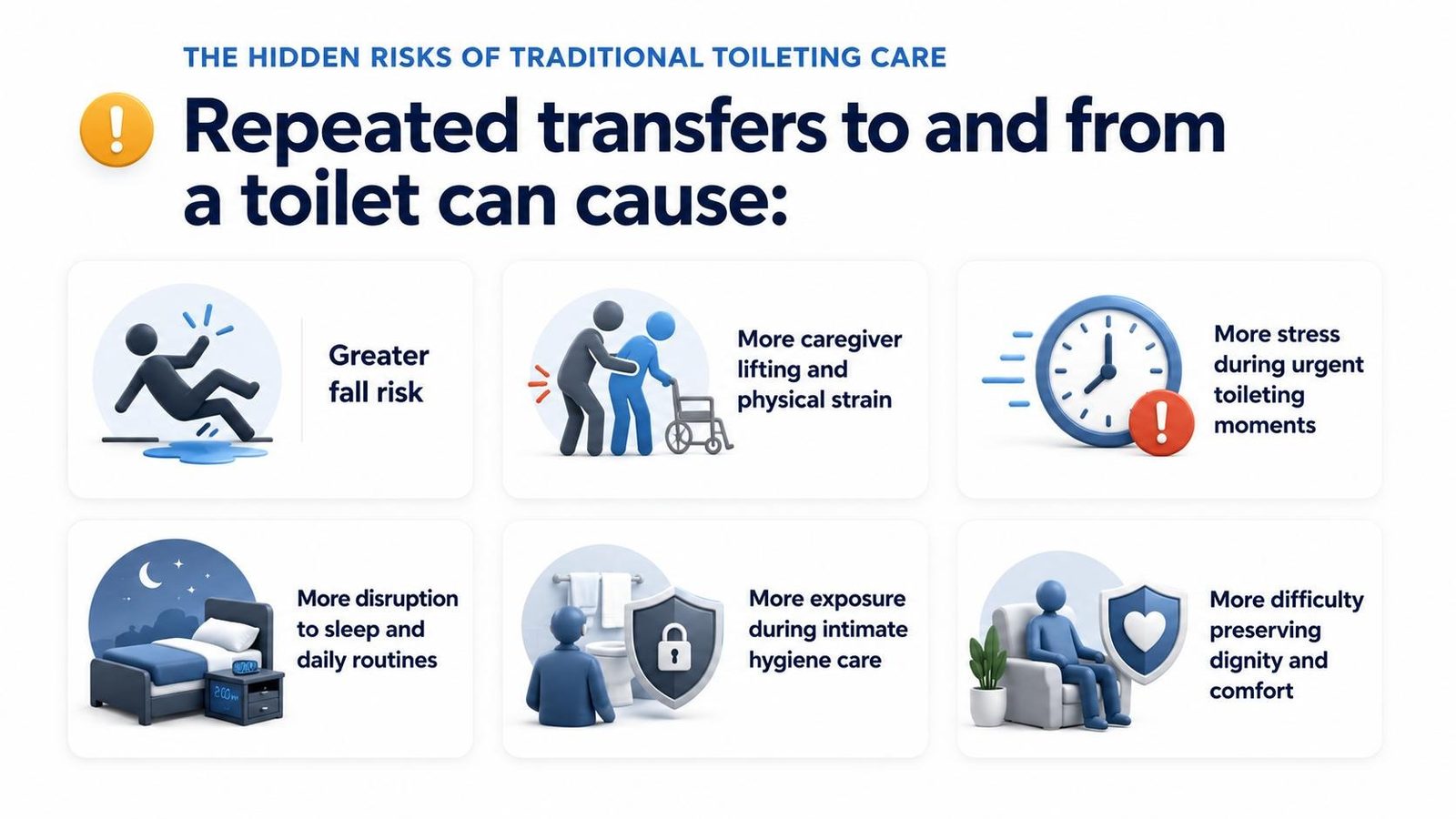
Toileting can require sitting up, standing, walking, turning, lowering, cleaning, redressing and returning to bed. When Parkinson’s symptoms fluctuate, the level of help needed can change quickly.
Stiffness, freezing or fatigue can make transitions more demanding.
Trips may happen when the room is dark and everyone is tired.
Repeated support with transfers and hygiene can become physically and emotionally exhausting.
When families start looking for help
Bathroom access is harder when symptoms, fatigue or poor lighting affect movement.
The need to go happens quickly, but movement takes time.
Families are managing more cleanup, bedding changes and hygiene care.
Transfers and nighttime assistance are becoming too demanding to manage alone.
How Carebidet may help
Carebidet is an intelligent, automated in-bed toileting care system. For Parkinson’s care, its role is to help families manage toileting when reaching the bathroom has become difficult, unsafe or unpredictable.
Parkinson’s Case Study
A Parkinson’s-specific case study for families and care partners reviewing toileting support options.
A Parkinson’s-focused resource showing how in-bed toileting care may support families as mobility, bathroom transfers, urgency, and caregiver demands become harder to manage.
Published articles for the Resource Library
These published sources support the page’s focus on Parkinson’s toileting, nocturia, urgency, urinary incontinence, and toileting-related fall risk.
A 2022 systematic review and meta-analysis found that LUTS, nocturia, urgency and urinary incontinence are common in Parkinson’s.
View PubMed sourceNocturia is described as an important non-motor symptom in Parkinson’s and a quality-of-life issue for patients and caregivers.
View full articleA prospective study associated urinary urgency with falls and reported that some falls occurred on the way to or from the toilet.
View PubMed sourceA clinical review discusses lower urinary tract symptoms in Parkinson’s and their quality-of-life impact.
View PubMed sourceA recent systematic review evaluates nonpharmacological and nonsurgical approaches for Parkinson’s lower urinary tract symptoms.
View PubMed sourceThis review explains that urgency, frequency, nocturia and urge incontinence can affect quality of life in Parkinson’s.
View PubMed sourceAdditional Parkinson’s Resources
A short list of trusted Parkinson’s organizations offering education, care partner guidance, helplines, local support, and practical tools.
Care partner resources, education, local chapters, and helpline support.
Education, support programs, and practical care partner guidance.
Care partner guides, research information, and family resources.
Living-well resources, webinars, care partner tools, and education.
Care partner support, education, programs, and community resources.
Explore Carebidet
Answer a few short questions and we’ll help you explore whether Carebidet may be appropriate for your situation.